
The condition
Tricuspid regurgitation.
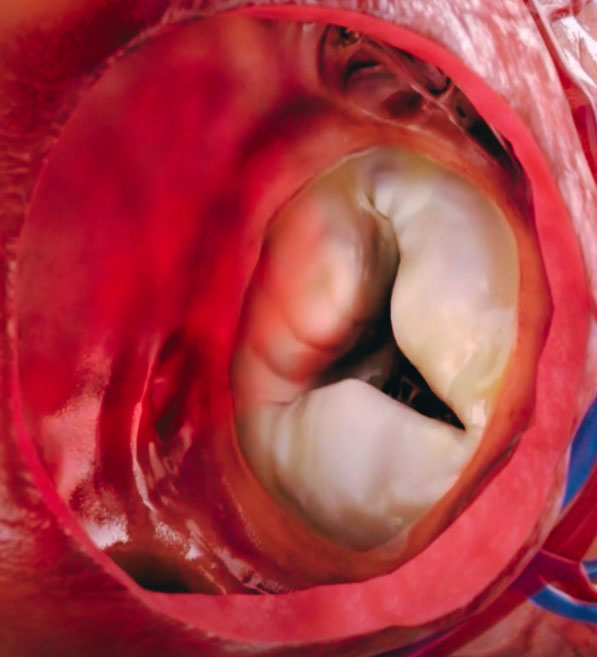
Tricuspid regurgitation (TR) occurs when the tricuspid valve fails to close properly, causing blood to leak backwards from the right ventricle into the right atrium.
The result is a progressive, self-reinforcing deterioration of cardiac function.
The condition
Tricuspid regurgitation.
Tricuspid regurgitation (TR) occurs when the tricuspid valve fails to close properly, causing blood to leak backwards from the right ventricle into the right atrium.
why it matters
Tricuspid regurgitation is serious.
When blood builds up in the right ventricle, it progressively dilates the right heart and overloads the venous circulation. TR may lead to a progressive deterioration of quality of life, heart failure, hospitalisation, and elevated mortality.
Patients suffer progressive shortness of breath with activity, extreme tiredness, swelling and heartbeat pounding.
In Europe alone, close to 3 million people live with TR.
Behind the data
A patient's reality.
Behind each statistic there are people: most often, but not only, in their seventies or eighties, whose daily life has been narrowed by breathlessness, swollen legs, fatigue, and recurring hospital admissions for heart failure. Many have been told their valve is too complex, or surgery too risky.
A device that provides durable results, implanted with a minimally invasive procedure and that works in complex tricuspid anatomies may be a life-changer for patients with no alternative options. It may mean fewer nights in a hospital bed and more time with family measured in years, not weeks.
a deadly disease
Severe TR carries a survival cost.
Patients with severe, untreated TR face elevated risks of right-heart failure, hospitalisation, and mortality. The clinical burden is well documented.
∼50%
more than half patients die within 5 years
Patients diagnosed with severe TR*
*Benfari, Giovanni et al. “Excess Mortality Associated With Functional Tricuspid Regurgitation Complicating Heart Failure With Reduced Ejection Fraction.” Circulation vol. 140,3 (2019): 196-206. doi:10.1161/CIRCULATIONAHA.118.038946
Treatment limitations
Limited treatment options, limited patient reach.
Surgery is effective but carries high mortality risks.
Thanks to their procedural safety, first-generation transcatheter devices can reach a larger but still limited patient population restricted to specific valve morphologies.
A transcatheter therapy with surgical-grade efficacy, the adaptability to a wide spectrum of tricuspid anatomies and the safety of a minimally invasive approach is very much needed.
Open-heart surgical repair
The proven reference for tricuspid repair, effective and durable but restricted to roughly three percent of patients who can tolerate open cardiac surgery.
Transcatheter repair (1st generation)
Devices originally conceived for the mitral and not for the tricuspid valve, they have paved the way to the safer treatment of a broader patient populations but their efficacy, durability and indication remain limited.
Transcatheter replacement
Transcatheter Tricuspid Valve Replacement (TTVR) is a last resort therapy for more serious cases where repair is not viable, it is associated with high serious adverse events risk and requires lifelong anticoagulation therapy.
tr treatments
Professor Alfieri explains TR.
An educational series authored by Prof. Ottavio Alfieri — pioneer of the surgical Clover technique and of the mitral edge-to-edge repair, the Alfieri’s Stitch.